lord, the room is dark and I am on my back again,
the songs break into notes into
vibrations. I string them like beads.
lord, let me sing to you.

o, lord, let me be a good man.
I do not know you,
lord, I think you’re all style,
the breath of the leaves
and the rot of the timber, but lord

let me walk with silver thought
and let these steps carry me
up the mountain, steeped in shadow,
slick with palm sweat and the doubt of the nations,

lord, I want to be a good man on this hill.
I kick the dirt and crush the earthworms
and maybe here is no place for me.

lord, I try to be a good man
but the forgiveness is hollow and nauseous.
it’s all form and no fill.

lord, lord, let the beggars and cripples
eat my body when I falter and fall.
no trace of me. memory melts into the dirt.
if I'm no good man let me make a good meal.

and, lord, I see you, I think,
arms crossed and uncrossing and
new born and long dead. don’t know
what to make of you. names don’t become us.

lord, I’m a beggar and a cripple
           and green eyed anger.
lord, I’m on my knees up this mountain.
is that good? is this right?
hello? the air is filled with dust
and I don’t know what to make of it.

lord, let me be a good man—
—but there’s no let and there’s no
man. no lord. lord, let these steps
carry me to the belied and beaten path so
that I might call myself a good man.

lord, they gave you a name because
they thought they could make you. you. no.
lord, we are not women and we are not men—
—we are carrying measures up the
mountain to put numbers to eternity.

lord let me. lord. hello? nevermind.
I’ll come up off my knees, then.
kiss the cripple and keep the sick in my pocket.
no good man, no man at all. lord, I’ll shut up now.
I’ll find a new name to whisper, o, lord,
o, lord.
Degas, Edgar. L’Absinthe or The Absinthe Drinker. 1875-76.
“We live together, we act on, and react to, one another; but always and in all circumstances we are by ourselves. The martyrs go hand in hand into the arena; they are crucified alone. Embraced, the lovers desperately try to fuse their insulated ecstasies into a single self-transcendence; in vain. By its very nature every embodied spirit is doomed to suffer and enjoy in solitude. Sensations, feelings, insights, fancies——all these are private and, except through symbols and at second hand, incommunicable. We can pool information about experiences, but never the experiences themselves. From family to nation, every human group is a society of island universes.”
-(?!)-
Huxley, Aldous. The Doors of Perception/Heaven and Hell. Harper Perennial, 1954.
Absinthe. I found this quote when I was flipping through the journal I kept over the summer. Not sure what it meant to me back in August, but now it makes for good inspiration.
Solipsistic crises would hit sporadically throughout adolescence; green moments of terror in realizing that who you are to yourself is exclusive content. I think, therefore I am shrivelled by the prospect of everyone else. What are these strangers? What are these friends?
I got over these moments pretty quickly because it was too absurd even for my tastes——just little old me out here? Really Descartes? I guess it all comes down to faith, then, a sort of conviction in one’s ability to graze the fibres of another being; conversation as proof of oneself.
Loneliness, however, I think is an essential condition of life isolated from any depressed philosophical takes, and Huxley speaks to that in contrast to our natural attempts at binding with another. Have you ever wanted to crawl into someone? You know what I mean, right? Siamese twin grafting surgery: “Embraced, the lovers desperately try to fuse their insulated ecstasies into a single self-transcendence; in vain”——it’s a natural sort of ambition that lives and dies in the arms of another. But they’re an-other, and so it stays there, something like a chemical reaction where the elements are isolated at the will of distance or heartbreak or compounded confusion.
It’s a necessary kinship that one makes with oneself, a survival pact taken upon realizing that it really is just this body and just this mind. Is that why we often regard ourselves in the second-person, I wonder? To cope with this conditional isolation? A severance of the mind and the reflection, the creation of the self-containing “you“: the way that Elliott Smith sings “nobody broke your heart/If you’re alone it must be you that wants to be apart”——what hangs in the mirror serves as a face to blame, the you that contradicts itself, a means of forcing company (“Alameda”).
But this, what I’m doing now, what Smith and Huxley do, “through symbols and at second hand”——is it working? Is it half-right in the eyes of the reader? Even in discussing the isolating nature of consciousness, Huxley offers a camaraderie in his analogy of “a society of island universes.” Society implies companionship antithetical to the described isolation. Perhaps when I wrote this quote down back in August it was out of an appreciation for its stark dissection, or maybe I just thought that it was well-written, but in this frigid December I find it to be vaguely optimistic despite the depressed connotations of the word “solitude.” We can’t help but try to make sense of it all, right? Despite our understanding that everyone will make a different sense of it? Solipsism shrivelled by the natural inclination towards faith in one and other, by our Sisyphean ventures to communicate the incommunicable through verse or song or conversation, even with the knowledge of it being in vain. “One must imagine Sisyphus happy,” or whatever (“Sisyphus”).
That got long. Sorry. It’s a good book, The Doors named themselves after it. Give it a read!
Camus, Albert. The Myth of Sisyphus. 1942. Translated by Justin O’Brien. Penguin Vintage Books, 2018.
Smith, Elliott. “Alameda.” Either/Or, Kill Rock Stars, 1997. open.spotify.com/album/5bmpvyP7UGq B4VuXmrJUMy?si=by4L9Qv4T2qxKAabuoqFkQ
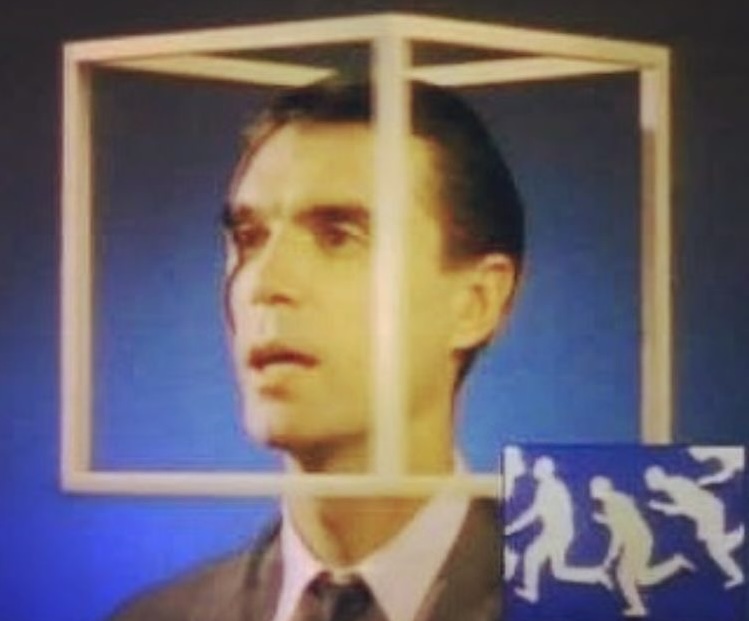
Wonderful track. David Byrne could release a twelve minute recording of a construction site ran through a synthesizer and I’d probably thank him for it. Not that he’d do that.
The message of “Heaven” has a couple sides to it: monotony is heaven, heaven is monotony——either works, really. For my purposes I’m more interested in the latter; the concept of eternity summarized as a night that forever repeats itself. It’s lovely. It’s hard to imagine. Here’s a ramble:
Eternity and its ilk are, by nature, difficult to wrap one’s head around. It’s one of those utterly beyond everything things. There’s a quote by the 14th-century Persian poet Hafez:
“Start seeing everything as God, but keep it a secret.”
I borrow this from a highly recommended essay published in the Harvard Divinity Bulletin: Kaveh Akbar’s “What Can Ancient Spiritual Poetry Teach Us about Living?”
Akbar (ironically, in this context) articulates a concept which I’ve often struggled to put to paper: the failings of language in the face of those cosmic things. In the noble attempt to put words to something so large, we accidentally render it small in the process. It’s a note that falls flat despite your best efforts. You can’t measure whatever ‘God’ or ‘eternity’ might be with metre, stick or iambic.
So eternity is one of those things that can be contemplated without end, without gain, and that’s kind of great, because it gives us all something to try and write about when the novel dries up. Talking Heads’ “Heaven” phrases eternity as cyclical stasis while Brian Eno goes at it on the keys:
“The band in heaven, they play my favourite song
Play it one more time, play it all night long”
      -(?!)-
“When this kiss is over, it will start again
Will not be any different, will be exactly the same.”
In this scenario, ‘heaven’ is a bar that everyone’s lining up for (purgatory? Why not), an immortal party where “nothing ever happens.”
I quite like this song. I quite like this interpretation of heaven’s advertised eternity; a place of cyclical nothingness. Our perception of time as a forward march conflicts with the concept of eternity as ‘forever and always,’ so to soothe this, eternity must exist out of time. Heaven must exist out of time, as a forever and an always. The kiss will always be starting, the kiss will always be ending, and the same song will always be playing.
Metaphor is maybe the closest we get to achieving a bridging of the gap between language and these self-imposed cosmic conflicts. The most accurate description of how I understand the concept of God and divine judgment comes from Mark Z. Danielewski’s House of Leaves: he writes that “God is for all intents and purposes an equal sign”——great, couldn’t have said it better. Hafez writes that God is a secret——fair enough, I think I get what he isn’t saying. David Byrne sings that “heaven is a place where nothing ever happens”——maybe. It makes less sense the more you think about it.
So we use the tools at our disposal as a means to bridge the impossible gap. Kind of like trying to fill a bottomless pit, which is logically flawed on multiple fronts, but something in us just really needs to find out whether it’s really bottomless or not, so we keep on with it, attempting to, as Kaveh puts it, “thin the membrane between us.” We’re all just trying to get to the bar.
Artists are, in a sense, exhibitionists, and exhibitionists are naturally terrible at keeping secrets (sorry Hafez). So we’ll keep looking for God in the material and eternity in the finite, and we’ll keep failing in our descriptions of those sporadic, shivering moments that we do find something——some type of legacy there, right?
Akbar, Kaveh. ‘What Can Ancient Spiritual Poetry Teach Us about Living?’ Harvard Divinity Bulletin, Autumn/Winter, 2022, bulletin.hds.harvard.edu/what-can-ancient-spiritual-poetry-teach-us-about-living/.
Danielewski, Mark Z. House of Leaves. Pantheon Books, 2000.
I have not lingered in European monasteries
and discovered among the tall grasses tombs of knights
who fell as beautifully as their ballads tell;
I have not parted the grasses
or purposefully left them thatched.

I have not held my breath
so that I might hear the breathing of God
or tamed my heartbeat with an exercise,
or starved for visions.
Although I have watched him often
I have not become the heron,
leaving my body on the shore,
and I have not become the luminous trout,
leaving my body in the air.

I have not worshipped wounds and relics,
or combs of iron,
or bodies wrapped and burnt in scrolls.

I have not been unhappy for ten thousand years.
During the day I laugh and during the night I sleep.
My favourite cooks prepare my meals,
my body cleans and repairs itself,
and all my work goes well.

  -(?!)-

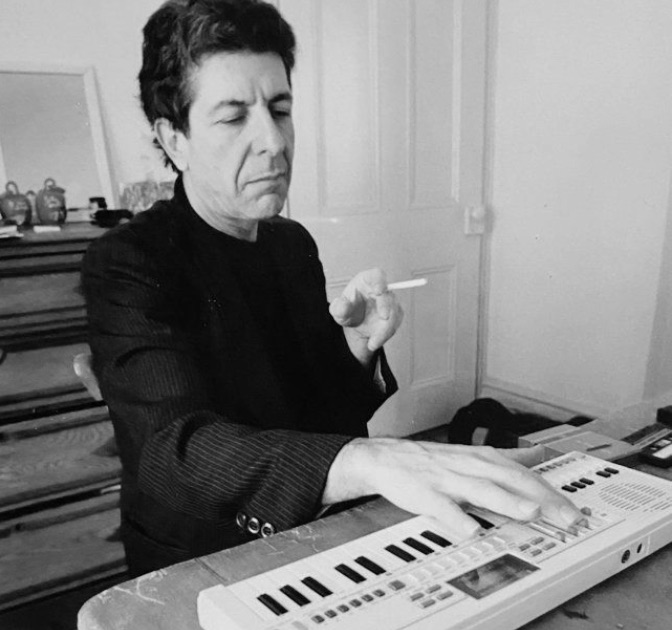
Cohen, Leonard. ‘I Have Not Lingered In European Monasteries’. The Spice Box of Earth, McClelland and Stewart, 1961.
My favourite Cohen poem. I take it as it lays.
Cohen was a Buddhist-Jew——regardless of that, this poem speaks to the agnostic in me, and the mild sort of worship that everyday things draw out. The way I stop and pay respect to the crows and cats I meet on my walk; the ritual washing of my guitars fretboard when I’m restringing it; the careful darning of a sentimental pair of socks. I may be without belief but I am not without reverence.
I appreciate the rejection of romanticism while at once endorsing it——art being aware of its own habits; the mundanity of a laundromat captured in a mosaic, or whatever. I think (‘I think,’ obviously) Cohen might be speaking to the concept of the anti-self; an idealism of ourselves conceived in fantasy, and the severance of that and the actual self. The anti-self commits themself completely to beauty or faith or whatever scenario appeals——dying on a cross, bacchanalia——while the actual self finds contentment in good food and legs holding steady beneath them.
The draw back to that take is the line “I have not been unhappy for ten thousand years”——this suggests more of a redemptive suffering angle; the act of committing oneself completely requires the rejection of all that lies outside of that commitment. Pope Francis died owning only a pair of black leather shoes, a Casio wristwatch, and a bible. That comes to mind.
Cohen was a man of faiths, but I think in this he is acknowledging that that is not his sole purpose. There’s a line from an MJ Lenderman song that speaks to this: “Every Catholic knows he coulda’ been a pope.”
I read Sylvia Plath’s The Bell Jar the summer I was sixteen, in the middle of an August heat wave while suffering a bad case of strep throat—metaphysically wasted and feverish and deeply moved. This song reminds me of her, y’know? I apologized to her as she lay open in my lap; I’m sorry for the world, you were too wonderful for it. I think I still hold that sentiment.
She was a wonderful illustrator, as well—neat black inkings of messy scenes and mundane objects; a junk heap, a discarded pair of kitten heels, a grazing cow.
I have one of her works on my arm, a french wine bottle corked with a burnt out candle. “Melancholy Man” is for the Plaths we miss, and the Cobains, the Elliot Smiths and the Virginia Woolfs—parasocial grief, maybe, but genuine nonetheless. Sympathy pains.
And when no hope was left inside, All that stardust fell and packed You took your life, as lovers often do But I could have told you this, too This world was never meant for one as beautiful as you (As beautiful as you, my melancholy man)
I could tell you about the beautiful, light and seemingly endless guitar track, or the ascending synthesizers, or the breathy sincerity in leading man Caesar McNulty’s voice—but you can find all that yourself when you listen, on the bus, in your car, on the sidewalk coming down off a hill. Enjoy.